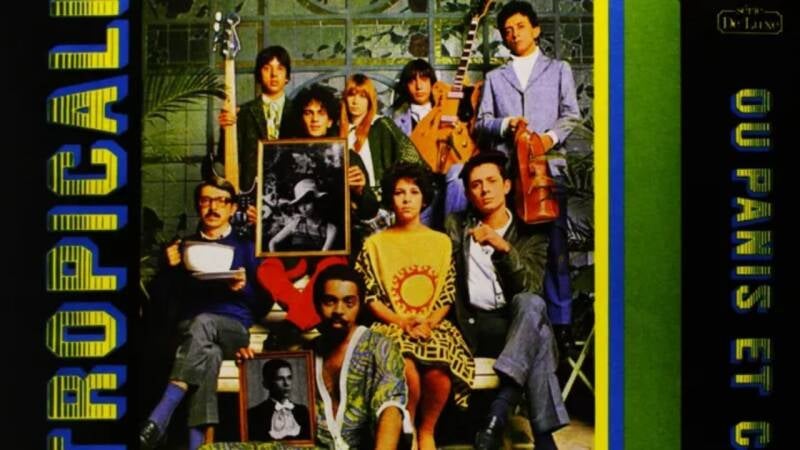
In the late 1960s, as Brazil sank into the darkness of a military dictatorship, a group of young artists from Bahia and São Paulo ignited a movement that would forever change the country's music, art, and politics. They called it Tropicália.
It was a movement that burned brightly for only a few years, from roughly 1967 to 1969, but its impact was seismic. Tropicália was not just a musical style. It was a cultural insurrection—a deliberate, playful, and deeply subversive assault on both the repressive military regime and the cultural gatekeepers of the Brazilian left.
The Birth of a Movement
The name itself came from an unlikely source: the visual arts. In 1967, artist Hélio Oiticica created an interactive installation featuring sand, palm trees, and simple structures modeled on the architecture of Rio's favelas. He titled it "Tropicália." The work was a critique of Brazil's image as a peaceful tropical paradise, exposing the brutality hidden beneath the postcard surface.
The musicians adopted the term. At the center of the movement was a core group of artists: Caetano Veloso, Gilberto Gil, Gal Costa, Tom Zé, and the psychedelic rock band Os Mutantes. They were later joined by collaborators like Nara Leão, Torquato Neto, and José Carlos Capinan.
What united them was a shared rejection of the cultural status quo. Brazil's military regime, in power since 1964, promoted a nationalist cultural agenda. They favored acoustic folk music and bossa nova, banning foreign influences to project an image of orderly nationalism. The Tropicalists saw this purism as a trap.
Cultural Cannibalism
The defining philosophy of Tropicália was "antropofagia"—cultural cannibalism. This concept, borrowed from the 1920s Brazilian modernist movement, meant devouring foreign influences, digesting them, and transforming them into something distinctly Brazilian.
The Tropicalists "cannibalized" the Beatles, Jimi Hendrix, psychedelic rock, French film, and cultural theory. They mixed this with samba, baião, and the deep Afro-Brazilian roots of Bahia. The result was a sound that was simultaneously cosmopolitan and profoundly local—electric guitars and orchestral arrangements colliding with traditional Brazilian rhythms.
The Manifesto Album
In 1968, the movement released its defining statement: the collaborative album "Tropicália ou Panis et Circencis". It was a collective work featuring Veloso, Gil, Costa, Zé, Os Mutantes, and others, with arrangements by maestro Rogério Duprat. The album was a sonic mosaic—psychedelic, orchestral, sardonic, and politically charged.
Caetano Veloso's song "Tropicália" was a fragmented allegory of Brazilian contradictions, touching on Coca-Cola, guerrilla groups, bombs, and Brigitte Bardot as part of the everyday experience. It critiqued both the dictatorship and the complacent middle class.
The Clash with the Left
Tropicália was not universally embraced. The Brazilian left, particularly the student movement and the supporters of MPB (Música Popular Brasileira), saw the Tropicalists as sellouts—tainted by foreign imperialism, politically unserious, and aesthetically decadent.
This tension exploded at the III Festival Internacional da Canção in São Paulo in 1968. Caetano Veloso and Os Mutantes performed "É Proibido Proibir" ("It Is Prohibited to Prohibit"). The audience, largely leftist students, booed and turned their backs. Veloso, in a moment of fury, launched into a legendary rant:
"But is this the youth who says it wants to take power? Do you have the courage to applaud this year a song, a type of music that you wouldn't have had the courage to applaud last year? You are the same youth who will always, always kill tomorrow the old enemy who died yesterday. You don't understand anything, anything, anything—nothing at all!"
He accused the audience of wanting to "police Brazilian music" and declared that he and Gil had come to "put an end to this festival, to all of the idiocy that reigns in Brazil".
The Regime Strikes Back
The military dictatorship did not find Tropicália amusing. The movement's irreverence, its mixing of high and low culture, its refusal to respect any authority—all of it was a threat.
In December 1968, the regime issued AI-5, a decree that suspended civil liberties, closed Congress, and unleashed a wave of repression. Artists were targeted. Caetano Veloso and Gilberto Gil were arrested, imprisoned, and eventually forced into exile in London. The movement effectively ended by 1969.
But the signal survived. As one analysis of the era's records noted, Tropicália tracks were banned from radio, so physical vinyl discs became the primary vector for transmission. They were traded underground, played at clandestine parties, wearing down with each play but spreading the message.
A Legacy That Endures
Tropicália's influence never truly faded. Os Mutantes' experimental psychedelia inspired a surge of interest from international listeners decades later. Talking Heads' David Byrne became a prominent champion of the movement, helping to bring it to global audiences. Caetano Veloso and Gilberto Gil, after returning from exile, became two of Brazil's most beloved and influential artists.
More than a musical style, Tropicália was a strategy—a way of being Brazilian that embraced contradiction, hybridity, and playfulness. It rejected the false choice between sterile nationalism and slavish imitation of foreign culture. It insisted that Brazil's identity was not a fixed essence but a constant, creative act of cannibalism.
As the movement's own manifesto declared: they had the courage to enter every structure and leave every structure. That spirit—restless, irreverent, and relentlessly creative—is why Tropicália still resonates today.